
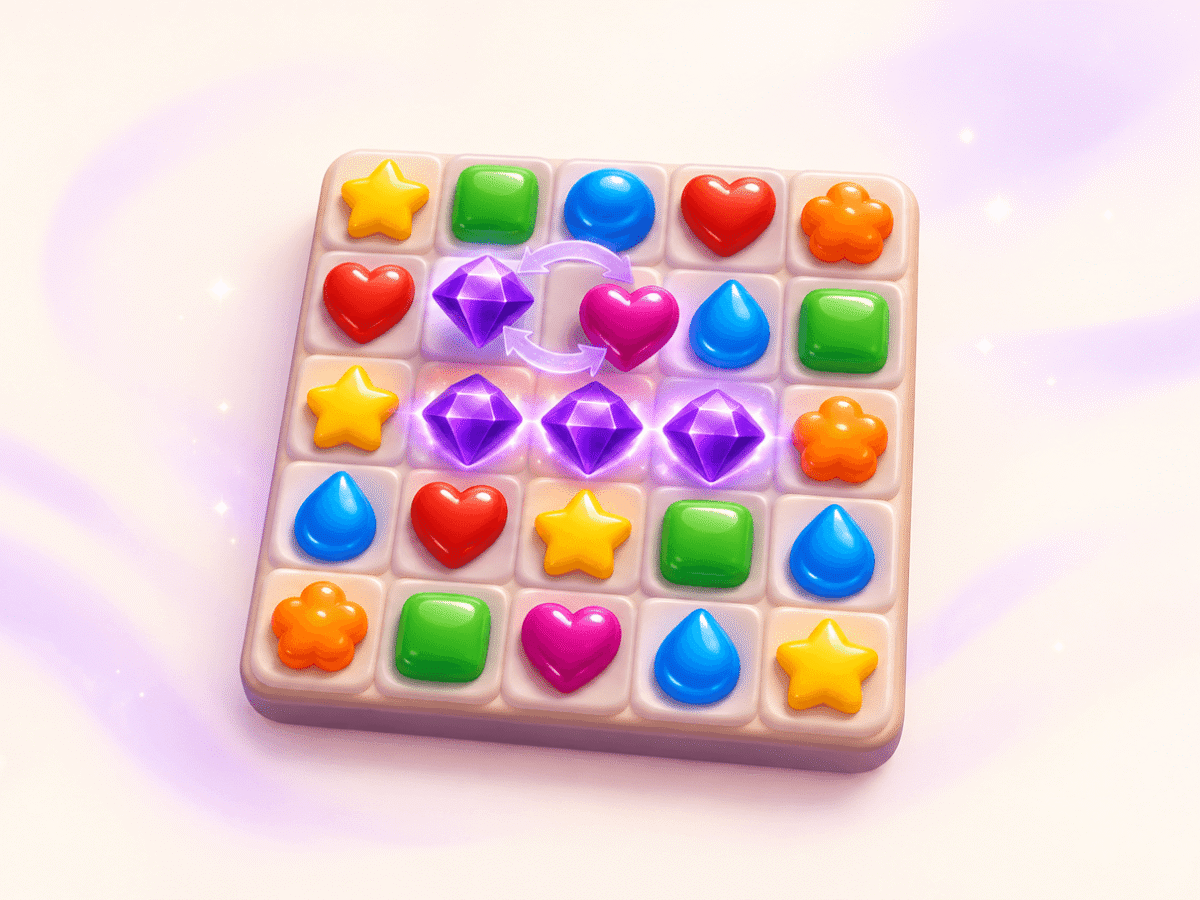
Match 3 is the puzzle almost everyone has played and very few people have been taught. The rule fits in one sentence — swap two neighbouring pieces to line up three of a kind — and everything interesting about the genre sits in what happens after that. This guide covers the vocabulary, the level types you will meet, and the handful of habits that separate a mediocre score from a good one.
The Rule, and What Follows It
The board is a grid of coloured pieces. You may exchange two pieces that sit next to each other, and the exchange is only legal if it produces a line of three or more identical pieces, horizontally or vertically. Matched pieces are removed, everything above them falls into the gap, and new pieces arrive from the top.
That falling step is where the game actually lives. Pieces that were nowhere near each other end up adjacent, and if the refill happens to complete another line, it clears too — without costing you a move. That is a cascade, and a long one is worth far more than the match that started it. Playing for cascades rather than for matches is the single biggest change most players can make.
The Vocabulary
- Board / grid — the playing field, usually eight or nine squares across.
- Swap — exchanging two adjacent pieces. The basic and often only action.
- Match — three or more identical pieces in a line.
- Cascade — a chain reaction caused by the refill after a clear.
- Power-up — a special piece created by matching four or five at once. A four typically leaves a piece that clears a whole line; a five leaves something that clears by colour.
- Blocker — ice, stone, chains or crates that cannot be swapped and must be broken by matching against them.
- Shuffle — what a game does when no legal move remains.
The Three Level Types
Nearly every match 3 level is one of three shapes, and knowing which one you are in decides how to play before you touch a piece.
Move-limited. You get a fixed number of swaps. The clock is irrelevant, so think as long as you like — but a match that does not serve the level goal is a move gone. Yummy Tales is a clear example: the animals need feeding within the moves you have.
Timed. A countdown is running, and in many games a larger match pays seconds back. Here a decent match taken now beats a better one found late, because searching costs the very thing you are trying to accumulate. Christmas Matching makes the exchange explicit: threes cost you time, fives buy it back.
Goal-based. The level names something specific — clear the ice, collect twelve carrots, bring an item to the bottom of the board — and the biggest match on screen is worthless if it does not touch that goal. Pool Party 3 gives a different objective on almost every board.
Five Habits That Raise a Score
- Read the goal before the board. Ten seconds spent on the level card saves more moves than any amount of clever matching.
- Play low. A clear near the bottom rearranges everything above it, so the same match is worth more there than at the top.
- Do not take a three when a four is one swap away. Power-ups are the entire late game, and they only come from larger lines.
- Aim at blockers, not at open board. Blockers rarely clear by accident, and a level that ends with one square of ice left is a level you lost early, not late.
- Keep the board mixed. A grid that has separated into neat colour regions looks tidy and quietly runs out of moves.
The Neighbouring Mechanics
Several genres get filed under match 3 that do not use the swap at all, and confusing them is a common source of frustration. In collapse games you click a group of touching same-colour pieces and it disappears — there is nothing to swap, and the scoring rises steeply with group size, so patience pays. In tile match you collect three identical objects into a small tray, and the tray, not the board, is what runs out. Bubble shooters are a third relative, where you fire pieces into a cluster from below.
All of them share a family resemblance, and none of them reward the same instincts. If a game feels wrong, check which one you are actually playing.
Common Questions
Do I need to install anything to play?
No. Every game linked from this guide runs in the browser on this site, free, with no download and no account.
Is there a way to always win a level?
No, and games that promise one are selling something. What raises your average is reading the goal first, playing for cascades, and saving power-ups for the level that has actually stopped you.
What is the difference between match 3 and collapse?
Match 3 asks you to swap two neighbouring pieces into a line. Collapse asks you to pick an existing group of touching pieces and remove it; there is no swap, and the whole skill is in choosing which group and in what order.
Why does the board shuffle by itself?
Because no legal move remained. A shuffle is the game rescuing you rather than ending the level, and frequent shuffles usually mean the board has separated into colour regions — keep it mixed and they stop happening.
Games mentioned in this article
- Bouncing Balls — filed under Bubble Games
- Forgotten Treasure 2 — filed under Jewel Games
- Forest Match — filed under Flower & Garden
- Garden Tales — filed under Flower & Garden
- Puppy Blast Lite — filed under Animal Games
- Zoo Boom — filed under Collapse Games